Comptroller of Puerto Rico reveals deficiencies in eligibility, project execution, and controls of the Department of Housing's R3 Program
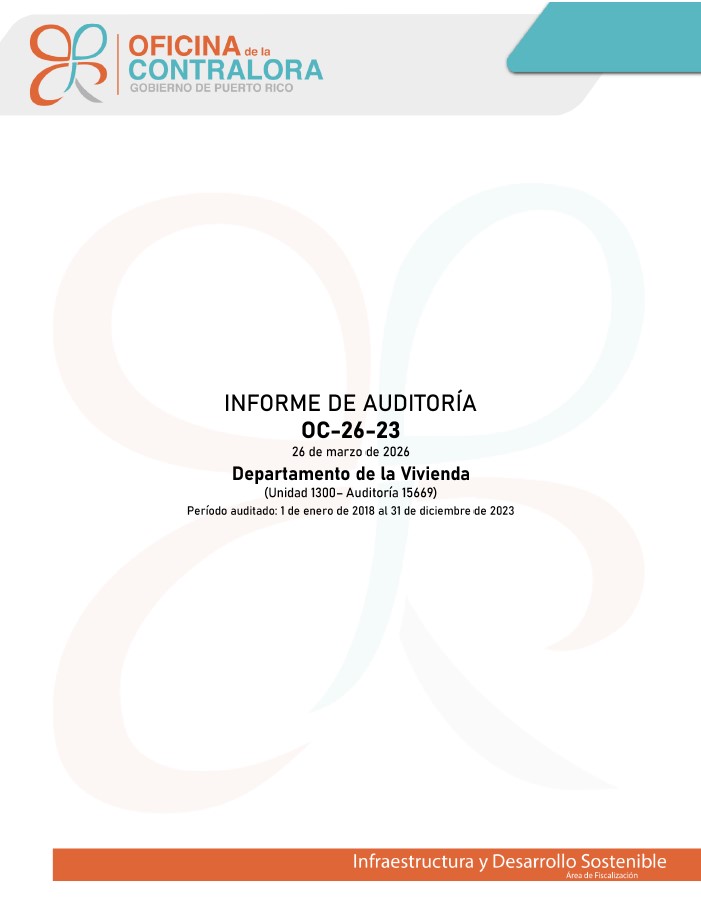
San Juan, Puerto Rico — (April 29, 2026)- The Comptroller of Puerto Rico, Attorney and CPA Carmen A. Vega Fournier, released the results of the Audit Report OC-26-23 of the Department of Housing, which covers the period from January 1, 2018 to December 31, 2023.
The report issued a qualified opinion upon determining that the Department's operations were carried out, in all significant respects, in accordance with the applicable law and regulations, except for findings 1 through 3, related to the administration of the Repair, Reconstruction, or Relocation Assistance Program (R3 Program), financed with federal CDBG-DR funds.
The audit evaluated the complete process of granting aid to citizens, from the application to the repair, reconstruction, or relocation of homes affected by hurricanes Irma and María, as well as compliance with the requirements established in the program guidelines.
Among the most relevant findings, a case was identified in which a property was reconstructed with public funds for more than $250,000 and was subsequently subject to mortgage foreclosure by a financial institution. In this case, the R3 Program disbursed $253,139 for the reconstruction of the home, which was never inhabited by the beneficiary, since the bank acquired the property through foreclosure proceedings before the completion of the work.
The audit determined that this situation had the effect of public funds benefiting private interests, because the program guidelines did not contemplate verification of mortgage payment status as an eligibility criterion.
In its comments, the Department's management indicated that mortgage debt does not constitute an ineligibility criterion under the provisions of the federal program, and that the inclusion of such a requirement would require a substantial amendment to the approved Action Plan. It also reported that efforts were initiated for the recapture of the funds disbursed in this case.
The second finding revealed that the R3 Program approved aid for applicants who did not provide the required documentation or who did not meet the established eligibility criteria. From a sample of 868 cases evaluated, multiple deficiencies were identified, including lack of evidence of identity, absence of documentation on income, inconsistencies in declared residence, and approval of aid for participants who exceeded the permitted income limits.
Among the cases examined, it was determined that a relocation voucher for $185,000 was granted to an applicant who did not meet the income requirements, evidencing failures in the validation and supervision processes.
The Department's management acknowledged that, even with established review processes, errors may occur or incorrect or fraudulent information may be presented by applicants, and stressed that the program has mechanisms for the recapture of funds in these cases.
The third finding is related to deficiencies in the execution of repair work on homes benefited by the program. The audit determined that payments were made for work not performed, as well as for work performed deficiently. In a sample of 324 inspected residences, noncompliance was identified in work such as roof installation, electrical systems, and other structural components.
In addition, deficiencies in the quality of the works were documented, including leaks, plumbing system problems, defective installations, and conditions that affect the safety of the residents. These situations show that the program's objective of providing dignified housing to beneficiaries was not fully achieved, despite the disbursements made.
The audit attributes these deficiencies to the lack of effective supervision by the R3 Program over the program and construction managers, as well as to the absence of adequate controls to guarantee compliance with the contracts and work orders.
In its comments, management indicated that it has implemented mechanisms within its policies and procedures to strengthen the supervision of the eligibility and project execution processes, as well as contingency measures such as construction guarantees and recapture of funds when applicable.
As part of the special comments, the audit included the results of a satisfaction survey of 834 program participants, which reflected an overall satisfaction level of 78%, although with mixed results on aspects such as communication of work progress and interaction with the construction managers.
Likewise, additional deficiencies were documented in reconstructed homes, including problems with windows, doors, roofs, electrical systems, plumbing, and other structural areas, which reinforces the need to strengthen quality controls in the projects.
As a result of these findings, the Office of the Comptroller issued recommendations directed at the Department of Housing, including the strengthening of internal controls in the evaluation of eligibility, the implementation of effective supervision mechanisms in the execution of works, the rigorous validation of the documentation presented by applicants, and the recovery of funds in the cases where applicable.
“The administration of public funds, particularly those directed at addressing critical needs such as housing, demands the highest level of diligence, transparency, and compliance. The findings of this report show areas that must be addressed with urgency to ensure that resources effectively reach those who truly need them and that the results meet the standards of quality and legality demanded by the public interest,” stated the Comptroller.
The complete report is available on the official website of the Office of the Comptroller of Puerto Rico ocpr.gov.pr.


Some documents on this page are saved in PDF format.
To view these documents, you must have the following free program installed.