Comptroller unveils deficiencies in collections and fiscal controls of the Police Bureau for 2021 to 2025
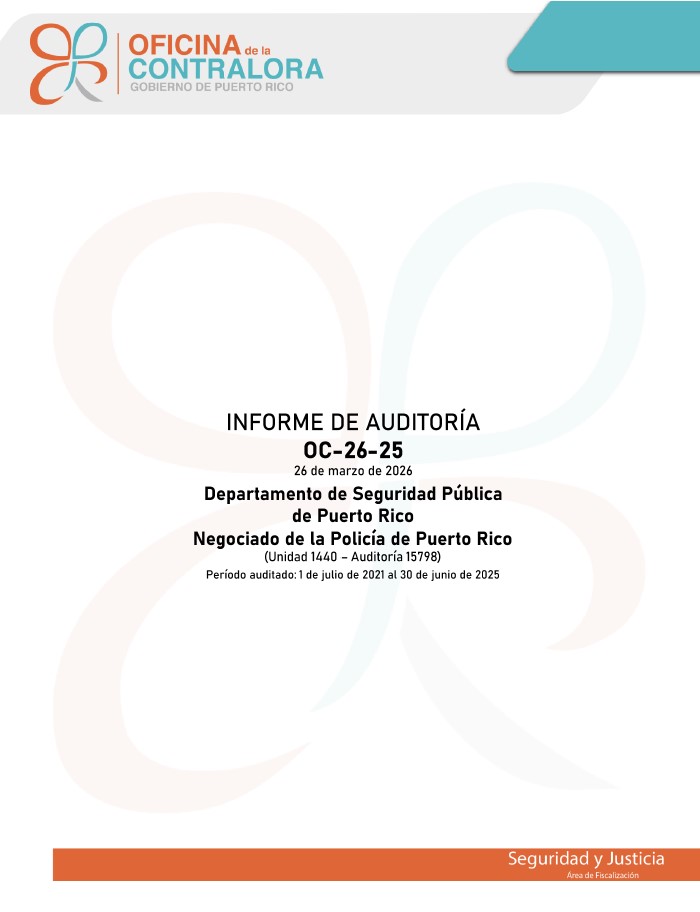
San Juan, Puerto Rico, (May 1, 2026) – The Comptroller of Puerto Rico, Attorney and CPA Carmen A. Vega Fournier, announced today the publication of the Audit Report OC-26-25 of the Puerto Rico Police Bureau (now the Puerto Rico Police), which was attached to the Department of Public Safety of Puerto Rico (DSP), in which the fiscal and administrative operations carried out during the period from July 1, 2021 to June 30, 2025 were evaluated.
The audit was carried out in accordance with the constitutional and legal powers of the Office of the Comptroller of Puerto Rico (OCPR), in which a qualified opinion was issued, which means that, although in general terms the operations examined were carried out in accordance with the applicable law and regulations in their significant aspects, findings were identified that require immediate corrective measures.
“Public safety also demands fiscal discipline, rigorous administrative controls, and absolute compliance with the rules governing the management of public funds. Every dollar properly administered strengthens the operational capacity of the State and citizen confidence,” stated Comptroller Vega Fournier.
The report contains two main findings: one related to deficiencies in the collections process and the other linked to conflicting functions in accounts receivable.
In the first finding of the Report, the OCPR examined the management of income generated by contracts for police services rendered to other governmental entities, private companies, and individuals, firearm storage, federal grants, joint operations with federal agencies, reimbursements, and other items. During the audited period, 2,489 remittance vouchers were recorded in the Treasury Area's Income and Collections System (SIRAT), containing 5,834 official receipts for $145,425,210 in collections of the Bureau. For audit purposes, 20 remittance vouchers were examined that included 333 official receipts for $11,927,154.
The audit determined that employees collected valuables without having an appointment as a substitute or auxiliary collector from the Department of the Treasury. In addition, 18 unofficial manual receipts were issued for $5,290, using forms created internally and not authorized by the Department of the Treasury. It was also found that no control was kept over the numbering and registry of those receipts.
Likewise, delays were identified in deposits of collections that ranged between 1 and 29 days, as well as official receipts that were not prepared at the time the valuables were received. In some cases, deposits were made between 1 and 82 days before the official receipts were issued. Inconsistencies were also detected between deposit slip dates and dates recorded in the SIRAT system, an illegible deposit slip without a bank stamp, and 247 official receipts that did not follow the corresponding numerical sequence.
According to the OCPR, these deficiencies demonstrate that adequate control was not maintained over the collections process, which can lead to errors, irregularities, improper use of funds, or hinder the timely detection of improper situations.
In its comments, the DSP acknowledged that the collection processes required review and updating. Nevertheless, it stressed that the audit did not identify losses of public funds and confirmed that the collections were deposited in full in the corresponding accounts, as well as remitted and recorded in SIRAT. In addition, it reported that it designated personnel as a substitute collector, implemented the use of authorized official receipts, and began training processes for the finance personnel.
For its part, the Police Bureau indicated that many of the findings occurred under the centralized administrative structure of the DSP before the new legal reorganization and that the recommendations will be incorporated into the operational transition process provided for by Act 83-2025, which created the new Puerto Rico Police with administrative and fiscal autonomy.
The second finding is related to conflicting functions in the accounts receivable area. As of June 30, 2025, the Bureau maintained 985 accounts receivable cases amounting to $980,233. The audit determined that the same employee performed the functions of preparing invoices, managing collections, and recording invoices and payments in the system, tasks that should have been segregated among different employees as a basic internal control measure.
The OCPR warned that this situation prevents adequate controls from being maintained over accounts receivable and increases the risk of errors or irregularities that might not be detected in time. It was also noted that a similar situation had previously been commented on in Audit Report DA-15-41.
The DSP responded that the limitation of personnel affected the adequate segregation of duties, but reported that it has already initiated a comprehensive evaluation of tasks, approved the creation of new positions, and is analyzing the incorporation of technological tools to alert cases without collection management and strengthen supervision.
One of the Comptroller's recommendations is directed at the superintendent of the Puerto Rico Police, to whom it indicates that he must ensure adequate supervision of the operations related to collections, ensure that those who handle valuables have valid appointments issued by the Department of the Treasury, that they use preprinted and authorized official receipts, require daily deposits, guarantee accuracy in SIRAT, and adequately segregate the functions of billing, collection, and recording of payments.
“As I have commented since day one, accountability is not limited to detecting failures; it also seeks to correct processes, strengthen institutions, and protect the public interest. We urge the agencies concerned to promptly implement each recommendation issued to ensure more agile, reliable, and transparent operations,” concluded Comptroller Vega Fournier.


Some documents on this page are saved in PDF format.
To view these documents, you must have the following free program installed.