Comptroller reveals administrative and fiscal deficiencies in the Guaynabo-Toa Baja Local Workforce Development Area.
Administrative failures were detected in tax withholdings and in the competitive processes
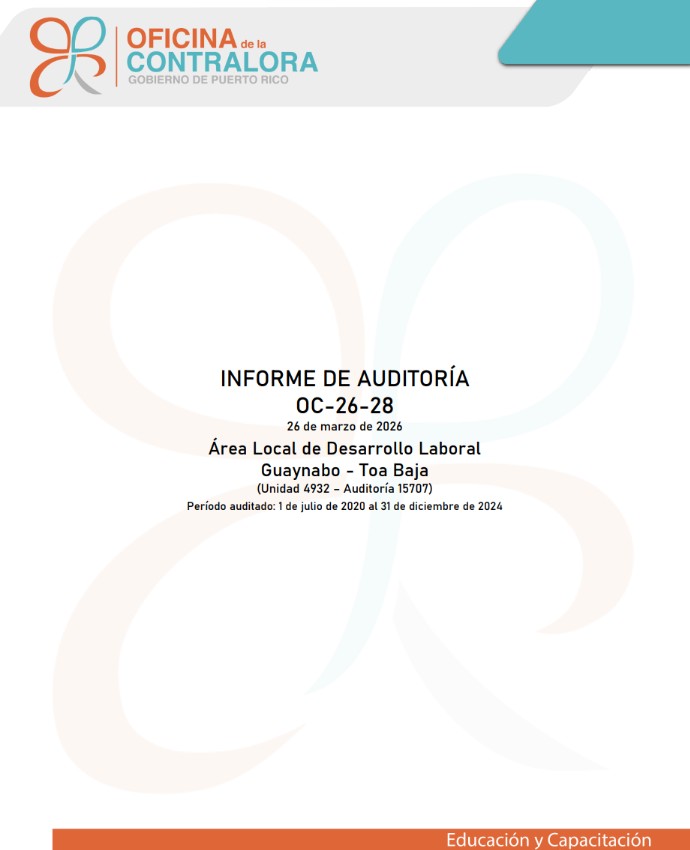
San Juan, Puerto Rico, (May 13, 2026) – The Comptroller of Puerto Rico, Attorney and CPA Carmen A. Vega Fournier, announced today the publication of Audit Report OC-26-28, corresponding to the Guaynabo-Toa Baja Local Workforce Development Area, in which multiple deficiencies were identified in the fiscal, contracting and public fund administration processes related to programs funded under the federal Workforce Innovation and Opportunity Act (WIOA). The audited period covered from July 1, 2020 to December 31, 2024.
The audit issued a qualified opinion, which means that, although in general terms the operations examined were carried out in accordance with applicable law and regulations, non-compliances contained in four main findings were detected.
“Public oversight does not only consist of reviewing numbers. It also requires examining whether processes are executed with transparency, adequate internal controls and strict adherence to the law. Every federal and state dollar must be administered with the utmost responsibility,” stated Comptroller Vega Fournier.
The report identifies four core observations: deficiencies in the pre-audit of invoices and tax withholdings, irregularities in proposal evaluation processes, insufficiency in the obligation of contractual funds and contracts without required clauses or certifications.
In the first finding, the Office of the Comptroller of Puerto Rico (OCPR) examined 80 invoices for $342,964 paid to contractors and determined that none contained the “Paid” stamp, a basic internal control mechanism to avoid duplication of disbursements. Likewise, in five invoices for $23,775 certifications required by law were not included and in four invoices for $15,775 the signature of the representatives of the supplier companies did not appear.
Additionally, in payments related to eight professional services and training contracts, it was detected that the tax withholdings required by law were not made
to three contractors, for a total of $1,281, depriving the Department of Treasury of legally enforceable revenues and exposing the entity to tax penalties.
The second finding reveals substantial failures in the competitive processes for awarding contracts. Between October 2020 and April 2024, the Executive Committee and the Youth Committee held 18 meetings to evaluate 893 service proposals. However, no formal evidence was preserved of the scores awarded by the Administrative Evaluation Committee, the evaluations were done in pencil and were not duly documented in the official files.
It was also found that in thirteen minutes the total of proposals received was not indicated, and in fifteen minutes the reasons for approving or rejecting the proposals evaluated were not recorded. Even, in a professional services contract for $20,000, the Executive Committee approved a proposal with a lower score without adequately justifying its decision.
The audit likewise determined that for 30 months the Executive Committee did not have the required regulatory composition. For some periods it had only one or two members with the right to vote, despite the fact that during that time it approved 615 proposals, a situation that weakens the legitimacy of the determinations adopted.
In the third finding, it was identified that in a contract for $10,000 for training services only $5,000 were initially obligated, causing a budgetary insufficiency equal to that amount. The remaining funds were obligated later, after payments under the contract had begun.
The Comptroller indicated that this type of practice can generate deficits in budgetary items and operational risks if funds were not available to cover previously assumed commitments.
In the fourth finding, the report notes a lack of essential contractual clauses and absence of required certifications in contractual files, which reflects additional weaknesses in contracting controls and regulatory compliance.
As a special comment, the report further mentions a case pending resolution before the Public Service Appeals Commission.
In its official comments, the management of the Local Area maintained that several situations responded to internal administrative practices, use of the SAP system, unofficial preliminary notes and operational limitations during the audited period. It also indicated that it has begun to implement corrective measures, including checklists, new documentary guidelines and reinforcement of the evaluation and filing processes.
Among the recommendations issued by the OCPR are to strengthen internal controls, ensure documentary evidence in all contracting processes, guarantee the regulatory composition of the decision-making committees, make tax withholdings in accordance with law, previously obligate the necessary funds before contracting and review the contractual files so that they contain all the required clauses and certifications.
“We urge the management of the Guaynabo-Toa Baja Local Workforce Development Area to promptly address each recommendation to protect public resources and strengthen services to citizens. Likewise, to send us the corrective plan and its respective achievements,” concluded Vega Fournier.


Some documents on this page are saved in PDF format.
To view these documents, you must have the following free program installed.