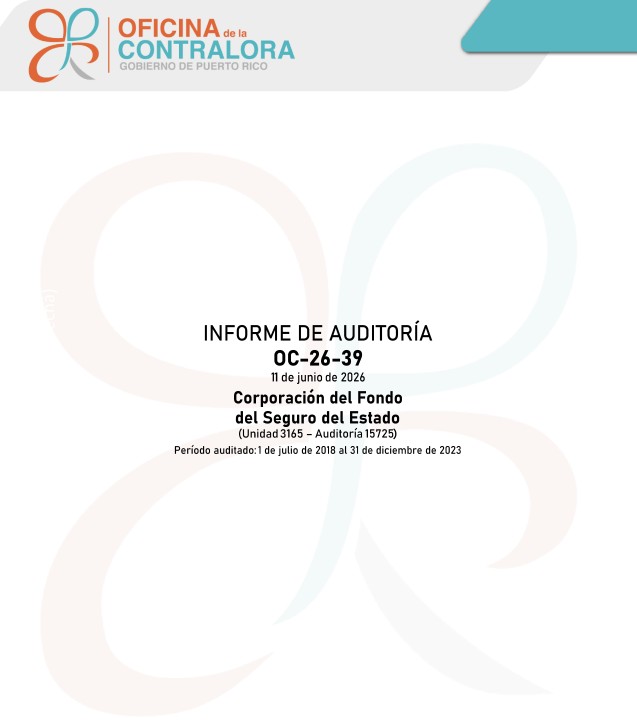
Comptroller notes deficiencies in payment agreements, contracting and fiscal controls at the State Insurance Fund Corporation
Audit identifies payment agreements contrary to law totaling more than half a million
dollars, payments without written contracts and deficiencies in budgetary
and pre-audit controls
San Juan, Puerto Rico – (June 22, 2026) The Comptroller of Puerto Rico, Attorney and CPA Carmen Vega Fournier, reported today the results of a compliance audit of the State Insurance Fund Corporation (CFSE), in which significant deficiencies were identified related to the use of payment agreements, the contracting of services, the budgetary control of medical contracts and the pre-audit processes for invoices. The audit covered the period from July 1, 2018 to December 31, 2023 and issued a qualified opinion, concluding that the operations examined were carried out, in general terms, in accordance with the applicable laws and regulations, except for the three findings contained in the report.
“The situations identified evidence weaknesses in administrative and fiscal controls that must be addressed promptly in order to protect public resources, strengthen institutional transparency and guarantee strict compliance with the legal provisions governing government contracting and disbursements,” said the Comptroller, who is an attorney and Certified Public Accountant (CPA) by profession.
One of the principal findings reveals that the CFSE executed 18 payment agreements totaling $539,523 that did not meet the exceptions authorized by Act 98-2009 for this type of mechanism. According to the audit, those agreements were used to cover expenses related to the Corporation’s administrative operations and not for exceptional situations directly linked to the medical and hospital care of injured workers, the specific purpose for which the legal exception was conceived.
The payment agreements examined included disbursements of $123,522 for the acquisition of durable medical equipment; $374,119 for services to collect, record, transport, store, handle, dispose of and destroy medical and administrative records; $6,512 for obtaining copies of records; and $35,370 for the payment of health certificates for Corporation employees. The Office of the Comptroller concluded that these items were not covered by the extraordinary circumstances contemplated by the legislation in force for authorizing payment agreements without prior contracts.
CFSE management maintained that the purchase of durable medical equipment constituted a direct service to the injured worker and that historically Regulation 7851 of 2010 had been broadly interpreted by the officials responsible for administering this mechanism. Likewise, the former administrator argued that the wording of the regulation in force allowed for diverse interpretations and suggested the approval of new, more specific regulations. Nevertheless, the Office of the Comptroller determined that the finding stands, concluding that the questioned disbursements were related to the Corporation’s administrative operations and not to the medical and hospital services contemplated by Act 98-2009.
The audit also identified that the Corporation made payments of $23,723 for the acquisition of professional services without written contracts existing between the parties, failing to comply with fundamental requirements of government contracting. The payments were related to health certificates for Corporation employees and medical transportation services. According to the report, the absence of written contracts made it impossible to establish clearly and precisely the obligations and responsibilities of the parties, increasing the risk of administrative irregularities and making it difficult to properly justify the disbursements made.
Another aspect noted by the auditors was the execution of payment agreements without having all the certifications required by regulation to validate the tax and fiscal standing of the suppliers. The audit identified agreements that lacked certifications from the Department of the Treasury related to the filing of returns and the absence of tax debts, as well as negative certifications from the Municipal Revenue Collection Center (CRIM), the Department of Labor and Human Resources and the Child Support Administration (ASUME), as applicable. The Office of the Comptroller warned that these omissions make it impossible to guarantee that the suppliers were current in their fiscal obligations and could limit the Government’s ability to recover outstanding debts.
The report’s second finding relates to the absence of effective budgetary controls over medical and professional services contracts. The audit determined that the officials responsible for the Medical Area and the Finance Area did not establish adequate mechanisms to monitor the consumption of funds allocated to professional and consulting services contracts. As a result, between May 2019 and November 2023 the Corporation approved 28 payment agreements totaling $1.7 million to meet obligations related to the Medical Area, including cases in which the contracts in force had exhausted their funds before their expiration or while contractual amendments were being processed.
The Corporation’s management argued that the nature of its institutional mission requires guaranteeing the continuity of medical services to injured workers, even when contracts have reached their budgetary limits. However, the Office of the Comptroller concluded that the responsibility for adequately monitoring and administering contractual balances rests with the Corporation itself and cannot be transferred to the service providers. According to the report, the absence of adequate controls limits the entity’s ability to evaluate the financial performance of its medical operations and could affect its economic and operational stability.
The third finding notes deficiencies in the pre-audit and review processes for invoices related to payment agreements. The auditors identified that 69 invoices totaling $98,774 were processed and paid without including the required certification of absence of interest, a document required by the Anti-Corruption Code to certify that no public official or employee has an economic stake or interest in the contracts covered by the invoicing.
Likewise, the Corporation was unable to provide for examination 98 invoices totaling $112,927 issued between 2014 and 2023. The absence of those documents made it impossible to verify in full detail the correctness and legitimacy of the payments made. The administration indicated that part of the documentation may have been affected by the circumstances related to the passage of Hurricane María and by operational changes in the systems used to handle invoices.
As a result of the findings identified, the Office of the Comptroller recommended that the Governing Board of the CFSE ensure that the administration implements the corresponding corrective measures. Among the principal recommendations is carrying out the steps necessary to recover the $539,523 disbursed through payment agreements executed in contravention of Act 98-2009, as well as the $23,723 paid for services rendered without written contracts. In addition, it was recommended to strengthen supervision of the Contracting Office, train the personnel responsible for contractual processes, implement effective budgetary controls over professional and medical services contracts, guarantee compliance with the certification requirements on invoices and reinforce the processes for the preservation and filing of fiscal documents.
The State Insurance Fund Corporation was created to protect injured workers and guarantee them medical treatment and economic compensation as part of Puerto Rico’s workers’ compensation system. During the fiscal years examined, the entity generated revenue of more than $3,542 million, made disbursements exceeding $2,581 million and made contributions to other government agencies of approximately $189 million.
“The importance of the Corporation for the protection of Puerto Rican workers demands rigorous administration, sound internal controls and strict compliance with the laws governing the use of public funds. Implementing the recommendations issued will contribute to strengthening institutional governance, protecting public resources and ensuring that services continue to be provided efficiently and transparently,” concluded Comptroller Vega Fournier.
Audit Report OC-26-39 can be obtained on our website: www.ocpr.gov.pr.


Some documents on this page are saved in PDF format.
To view these documents, you must have the following free program installed.