Comptroller notes deficiencies in the collection of more than $2.3 million
in leases of the Puerto Rico Land Administration
Audit identifies accumulated delinquent accounts, insufficient collection efforts and the write-off of nearly $1 million in debts without exhausting all recovery actions
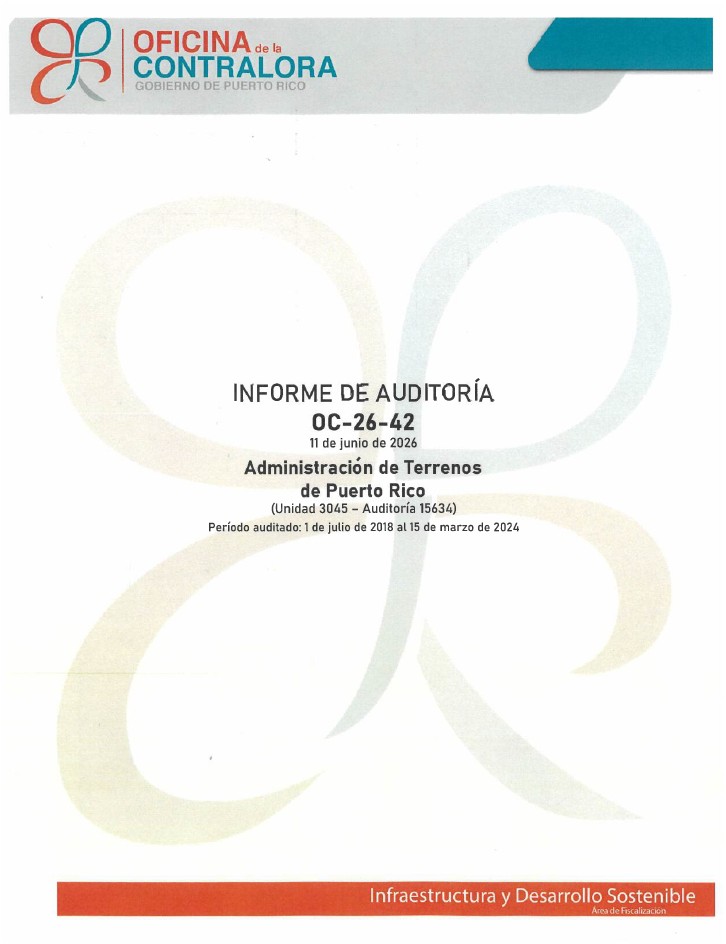
San Juan, Puerto Rico – (June 18, 2026) The Comptroller of Puerto Rico, Attorney and CPA Carmen Vega Fournier, reported today the results of a compliance audit of the Puerto Rico Land Administration (the Administration), in which significant deficiencies were identified related to the control and administration of accounts receivable arising from lease contracts of properties belonging to the entity, as well as non-compliance related to the submission of reports required by the Office of the Comptroller of Puerto Rico.
The audit covered the period from July 1, 2018 to March 15, 2024 and issued a qualified opinion, concluding that the operations examined were carried out, in general terms, in accordance with the applicable law and regulations, except for the findings related to the handling of accounts receivable and the late submission of reports on the Registry of Positions.
“The proper administration of accounts receivable is one of the essential elements for the financial stability of any public entity. The situations identified in this audit evidence weaknesses in the collection and follow-up processes that require immediate corrective action in order to protect public resources and maximize the recovery of revenue owed to the Government,” said the new Comptroller.
The Administration uses its inventory of properties for short- and long-term leases, as well as for economic and social development projects. As part of those operations, it generates revenue through lease contracts for land and properties under its control. As of June 30, 2023, the entity maintained 144 accounts receivable for leases totaling $2,317,171. Of these, 109 accounts totaling $2,005,984 were more than 90 days past due, representing 87% of the total owed.
The audit determined that the Office of Budget and Finance did not carry out effective collection efforts or analyze the delinquency of the accounts receivable on a quarterly basis, as required by the regulations in force. Nor did it prepare the reports required to classify the accounts by category, or prepare for the evaluation of the Accounts Receivable Committee a list of the accounts it estimated to be uncollectible. In addition, the director of that Office did not document the determinations regarding which accounts should be the subject of collection efforts.
As part of the examination, the auditors evaluated 16 accounts receivable totaling $1,405,260, of which 15 totaling $1,224,256 were more than 90 days past due. The analysis revealed that the efforts made to recover those debts were insufficient or inadequate, in many cases limited to sending a few collection letters, without evidence of subsequent follow-up or of additional actions to recover the funds owed.
The most significant situation identified by the audit relates to the elimination of accounts through the “write-off” mechanism. Between June and November 2023, the Administration removed from its accounting records eight lease accounts totaling $1,057,987, having deemed them uncollectible. However, the examination revealed that in several cases all the required collection efforts had not been exhausted before proceeding with that elimination.
In four accounts totaling $495,235, the efforts made were minimal or nonexistent. Moreover, at the time of the audit, some of the lessees continued to occupy the leased properties, even though the debts had been declared uncollectible and removed from the Administration’s books.
The audit also found two accounts totaling $261,117 for which no collection efforts were made following judgments issued by the courts in favor of the Administration. In these cases, there were judgments for more than $237,000 and $23,000 respectively, but no evidence was found of effective efforts to enforce those judicial determinations before removing the debts from the accounting records.
Likewise, an account for $221,836 was administratively written off even though the Administration had an active court case for the collection of money related to that debt. According to the audit, this action was incompatible with the regulatory provisions that require exhausting all reasonable collection alternatives before considering a debt uncollectible.
Another case examined corresponded to a debt of $64,341 on which the Administration had made no collection efforts during the seven years prior to the audit. The last documented effort occurred in February 2017, even though the lessee was failing to comply with a previously approved payment plan and also failed to comply with the obligations arising from a new lease contract executed subsequently.
The Office of the Comptroller concluded that the lack of adequate controls and of timely collection efforts led to the aging of the accounts, hindered the recovery of the funds owed and caused numerous debts to be considered uncollectible. As a consequence, the Administration removed from its records close to $978,188 in accounts receivable, a situation that directly affects the entity’s financial health and limits its ability to maximize the revenue derived from its leased properties.
During the audit process, the former president of the Governing Board indicated that the write-off of the accounts receivable was authorized by the Board after receiving the recommendation of the Accounts Receivable Committee and of the then executive director, in accordance with the Regulation for the Control, Collection and Disposition of Accounts Receivable of the Land Administration.
Nevertheless, the audit concluded that the collection efforts required by the regulations were not adequately exhausted before the write-off of those accounts was authorized.
The audit also identified deficiencies related to compliance with Act 103-2006 and Regulation 53 of 2008, which require the periodic submission to the Office of the Comptroller of the monthly reports of the Registry of Positions and Related Information. The examination revealed that, of the 48 reports submitted between July 2018 and June 2022, eight were presented late, with delays ranging between four and 114 days after the established deadline.
According to the report, these delays deprived the Government and the public of updated and timely information on payroll, filled positions, vacancies and other data related to the entity’s human resources administration. The audit attributed the situation to non-compliance by the liaison officers responsible for submitting the information and to the lack of adequate supervision over that process.
As a result of the findings identified, the Office of the Comptroller recommended that the Governing Board ensure that the executive director implements corrective measures to strengthen the control of accounts receivable. Among the principal recommendations are requiring the Office of Budget and Finance to carry out quarterly analyses of the accounts receivable, prepare reports classified by category, promptly identify potentially uncollectible accounts and carry out continuous and duly documented collection efforts. In addition, it was recommended that the monthly reports required by law be submitted within the established time frames.
The Puerto Rico Land Administration was created by Act No. 13 of 1962 for the purpose of promoting economic and social development through the efficient use of public lands. The entity operates primarily on its own revenue generated by the lease and sale of properties. During the period from July 1, 2018 to June 30, 2023 it generated revenue of $81.7 million and made disbursements of $53 million, reflecting an accumulated surplus of approximately $28.6 million.
“The effective recovery of accounts receivable is an essential responsibility of every public entity. Every dollar that goes uncollected represents resources that could be used to advance economic development projects, infrastructure and services for the public. The recommendations issued seek to strengthen administrative processes and protect the patrimonial interests of the people of Puerto Rico,” concluded attorney and CPA Vega Fournier.


Some documents on this page are saved in PDF format.
To view these documents, you must have the following free program installed.