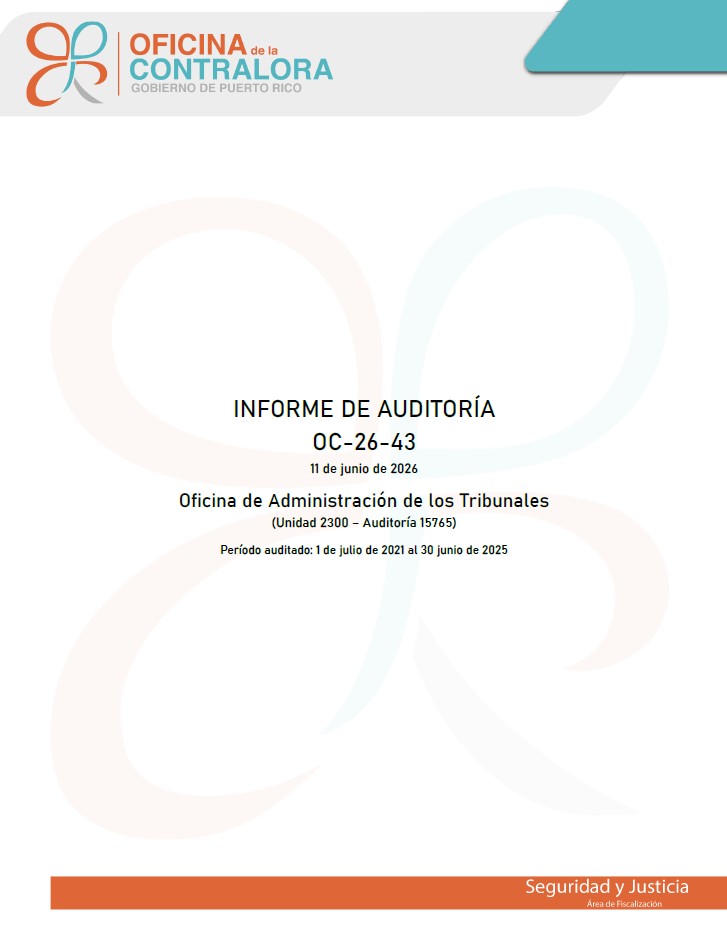
San Juan, Puerto Rico – (June 23, 2026) – The Comptroller of Puerto Rico, CPA and Attorney Carmen Vega Fournier, revealed the results of a compliance audit of the Office of Court Administration (OAT), in which deficiencies were identified related to the use of technological resources acquired for the Office of Fiscal and Operational Audit, as well as the prolonged inactivity of the Judiciary’s Internal Audit Committee.
The audit covered the period from July 1, 2021 to June 30, 2025 and issued a qualified opinion, concluding that the operations examined were carried out, in general terms, in accordance with the applicable legal and regulatory provisions, except for the situations noted in the two findings contained in the report.
“The responsibility of every public entity is to ensure that the technological and financial resources acquired with public funds produce concrete benefits for the public and strengthen institutional efficiency. The situations identified in this audit evidence areas that require attention in order to ensure the effective and responsible use of public resources,” said the Comptroller.
One of the principal findings of the OCPR’s auditors in the report relates to the acquisition of specialized audit software for the Judiciary’s Office of Fiscal and Operational Audit. Through a contract executed on November 2, 2020, the OAT acquired ten licenses for an audit system, together with installation, configuration, advisory, training and technological implementation services, at an initial cost of $84,740. The purpose of this tool was to optimize, automate and standardize internal audit processes, as well as to strengthen the supervision of the Judiciary’s fiscal and operational transactions.
Subsequently, between January 2021 and January 2024, the OAT disbursed a total of 119,483 related to the acquisition, installation, training and maintenance of the system. The payments included $38,100 for the licenses, $12,483 for the implementation
of cloud storage, $10,200 for training, $4,269 for advisory services, $1,494 for installation and configuration, and $52,937 for maintenance over three consecutive years.
However, the audit determined that, as of June 30, 2025, the Office of Fiscal and Operational Audit had not used the software to carry out audits or for the work for which it was acquired, even though the licenses were installed and the auditors received the corresponding training for its use. In fact, the director of the Office of Audit recommended in December 2024 that the system’s maintenance not be renewed because it was not being used, a recommendation that was accepted by the administration.
The Office of the Comptroller concluded that this situation caused the OAT to invest $119,483 in public resources without these producing any utility or tangible benefit for the public interest. It also noted that those funds could have been used for other operational needs of the Judiciary.
During the audit process, OAT management maintained that the software was in fact used to configure templates, create electronic cabinets, store information and develop risk evaluation parameters, as well as to carry out training processes and tests related to the technological tool. The administration argued that the report started from an incorrect premise in assuming that the validity of the investment depended on the system being the only mechanism used to carry out audits.
Nevertheless, the Office of the Comptroller’s auditors determined that the finding stands. According to the report, the activities described by the OAT corresponded to installation, configuration and preparation tasks necessary to put the tool into operation, but the software was never used to carry out audits or to execute the specific work that originally justified its acquisition. In the judgment of the Office of the Comptroller, after more than four years since the purchase of the system, it had not fulfilled the purpose for which it was acquired.
The report’s second finding relates to the inactivity of the Judiciary’s Internal Audit Committee. The audit revealed that this committee has not operated since April 15, 2014, so that at the close of the audited period it had been inactive for more than eleven years.
This committee was created by an administrative order issued by the then Chief Justice of the Supreme Court in 2007 for the purpose of strengthening the independence, integrity and reliability of the internal audit function, in addition to advising on matters related to the oversight of the Judiciary’s operations. The rules provide that its members must be designated by the Chief Justice and that the committee must render annual reports on its activities.
The Office of the Comptroller concluded that the absence of this body affects the independence and reliability of internal audit activities and limits the Judiciary’s ability to have additional supervisory mechanisms over the transparency and correctness of its fiscal processes.
In response to the finding, OAT management argued that the committee fulfilled the purpose for which it was originally created, related to a prevention and anti-corruption program implemented almost two decades ago, and maintained that there is no legal obligation to reconstitute it. It also noted that the Office of Audit continues to operate with independence and reliability in accordance with the Judiciary’s rules in force.
The Office of the Comptroller rejected those arguments and determined that the finding stands. The report emphasizes that Administrative Order OAJP-2007-53 remains in force and that the existence of audit committees is a widely recognized practice in international internal audit standards for strengthening the independence of the oversight function and promoting institutional transparency.
As a result of the findings identified, the Office of the Comptroller recommended that the Chief Justice of the Supreme Court designate the members of the Internal Audit Committee and ensure that this body resumes its functions. Likewise, it recommended that the Administrative Director of the Courts implement measures to ensure that the software and technological equipment acquired by the Judiciary are used for the purposes for which they were acquired and produce concrete benefits for the public interest, and that a corrective plan be submitted to us whose compliance will be evaluated within the next six months.
The OAT is the body responsible for providing administrative support to the operation of Puerto Rico’s judicial system. During fiscal years 2021-2022 through 2024-2025 it received appropriations totaling $505.7 million and made disbursements of $470.6 million, maintaining an accumulated balance of approximately $35.1 million.
“Investment in technology and internal oversight mechanisms must respond to effective planning and produce concrete results that strengthen public administration. Transparency, accountability and the responsible use of public resources continue to be fundamental elements in strengthening public trust in our institutions,” concluded Attorney Carmen Vega Fournier.


Some documents on this page are saved in PDF format.
To view these documents, you must have the following free program installed.