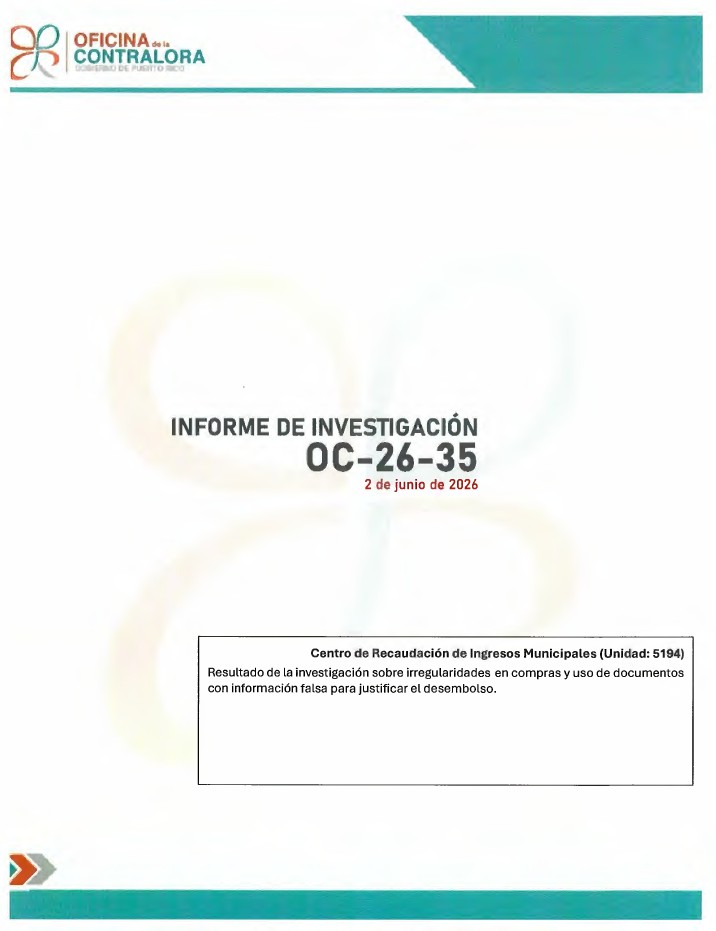
San Juan, Puerto Rico – (June 2, 2026) The Assistant Comptroller of the Legal Area, Attorney Rafael Vázquez, reported the referral to the Department of Justice and the Office of Government Ethics of findings related to alleged irregularities in the purchasing and disbursement process at the Municipal Revenue Collection Center (CRIM), which included the use of documents with false information to justify payments with public funds.
The investigation, conducted by the Special Investigations Division of the Office of the Comptroller of Puerto Rico (OCPR), corresponding to the period from February 17 to July 18, 2023, arose following the receipt of a complaint related to the processing of a purchase and the corresponding disbursement at the agency.
According to the report, the investigation included interviews, the gathering and analysis of documentary and testimonial evidence, review of internal systems and external validation of information provided by officials and suppliers.
As a result, administrative actions in non-compliance with the applicable law and regulations were identified that culminated in the approval and payment of a purchase order backed by documents with false and incorrect information.
The main finding exposes that the CRIM Governing Board processed a purchase order for $1,000 for the acquisition of food originally intended for a regular meeting scheduled for February 23, 2023. After the cancellation of the meeting, officials took steps to justify the disbursement by alleging that the food had been used in a supposed “Movable Property Training for the CPA Association.”
“However, the investigation corroborated that said training was never offered. The executive director of the Association of Certified Public Accountants certified that this entity did not receive or provide training at the CRIM during the date indicated. Likewise, CRIM employees who appeared on attendance lists certified that they did not participate in any training and that their signatures were required to justify the payment related to the food,” noted Vázquez, who added that the investigation also revealed that, as part of the supporting file for the disbursement, an email requesting alteration of the budget account originally used for the purchase, a certification signed by an official affirming false information, and attendance sheets linked to a nonexistent activity were used.
In addition, it was determined that the purchase was processed using a single quote, without complying with the regulatory requirements of fair competition among representative market suppliers, a situation that may foster payments at inflated prices and limit transparency in the use of public funds.
The OCPR concluded that the situations detected reflect significant deficiencies in compliance with the law and a marked absence of internal controls in the processes of purchasing, approval and justification of payments within the CRIM.
The report further notes that the creation and use of false documents, as well as the certification of nonexistent activities, compromise administrative integrity, evidence a lack of ethics in the performance of officials and could constitute violations of the Penal Code of Puerto Rico.
In light of these findings, the Office issued referral RDIE-1464-5675-26-56 to the Department of Justice and the Office of Government Ethics for evaluation and appropriate action. Likewise, it recommended that the CRIM Governing Board consider the corresponding administrative referral and immediately strengthen its purchasing, disbursement and supervision processes to prevent similar situations from recurring.
“The handling of public funds requires absolute transparency, effective controls and strict compliance with the law. When false documents are used or nonexistent activities are certified to justify disbursements, public trust is compromised and the integrity of government service is undermined,” stated the Assistant Comptroller.
The report highlights the urgent need to implement corrective actions and reinforce the oversight and internal control mechanisms to ensure that public resources are administered with integrity, honesty and in accordance with current law and regulations.


Some documents on this page are saved in PDF format.
To view these documents, you must have the following free program installed.