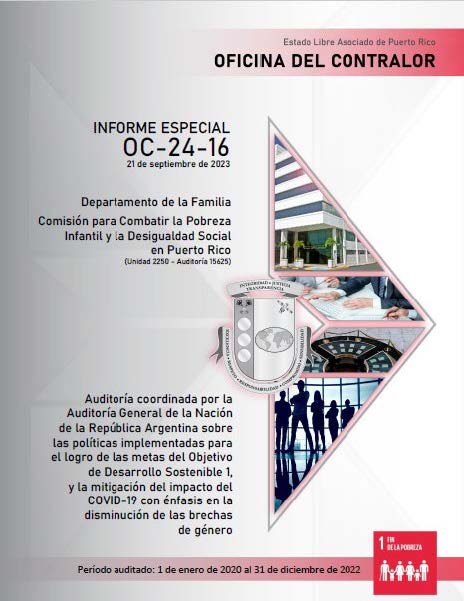
The Comptroller of Puerto Rico published a coordinated audit on the effectiveness of public policy actions to: reduce poverty and child poverty, mitigate the impact of COVID-19, and reduce the gender gap. The audit, led by the Auditor General of Argentina, analyzes Puerto Rico's outlook with respect to the Sustainable Development Goal, End of Poverty, according to the United Nations 2030 Agenda.
The Special Report reveals that, although a legal framework was established to mitigate the impact of the COVID-19 pandemic through the creation of an Advisory Commission by Executive Order on May 25, 2021, it was not in operation nor was a structure created for its implementation. The Advisory Commission was made up of 11 officials who only met on one occasion.
The audit indicates that the Executive Order did not include methods of citizen participation nor actions to reduce the gender gap to address the objectives. In addition, the eight representatives of universities, the private sector and nonprofit entities on the Advisory Commission were not appointed.
The Government of Puerto Rico established on December 31, 2021, the Commission to Combat Poverty through Act 84-2021, to reduce child poverty and social inequality by 50% by 2032, among other objectives. According to data from the United States Census as of 2022, 42% of the population and 58% of those under 18 years of age were living in poverty on the island.
However, the necessary mechanisms to meet the objectives were not established, since state and federal initiatives were not integrated with those of the municipal governments, nonprofit entities and the private sector. In addition, the Commission had not prepared a strategic plan, nor a list of the funds available at the federal and state level, and the law also did not include methods of citizen participation, among others.
For fiscal year 2023, a budget of $1,200,000 had been approved to fund the Program against Child Poverty. However, as of January 20, 2023, these funds had not been used. This situation prevented measuring the progress in reducing child poverty.
With respect to the achievement of the goals to mitigate the impact of the COVID-19 pandemic and the reduction of the gender gap, the Report indicates that a campaign was implemented to promote the application for the child tax credit, but no actions additional to the public policy of reducing child poverty and poverty were established. As of October 6, 222,327 returns had been filed with the Federal Internal Revenue Service claiming the child tax credit. This represented 73% of the total families that qualified. In the long term, the impact of these funds cannot be determined since it is not a recurring aid.
The Special Report lists the federal and state programs, and their purpose to mitigate poverty by Government agency. In addition, it details the amount of the various laws and programs of the Government to address the COVID-19 pandemic such as the CARES Act, the CRTRA Act and the ARPA Act, among others.
The Special Report covers the period from January 1, 2020 to December 31, 2022.
Audit Report OC-24-16 can be obtained on our Internet page: www.ocpr.gov.pr.


Some documents on this page are saved in PDF format.
To view these documents, you must have the following free program installed.