Comptroller reveals noncompliance with roughness specifications and multiple irregularities in the construction of the Cable-Stayed Bridge
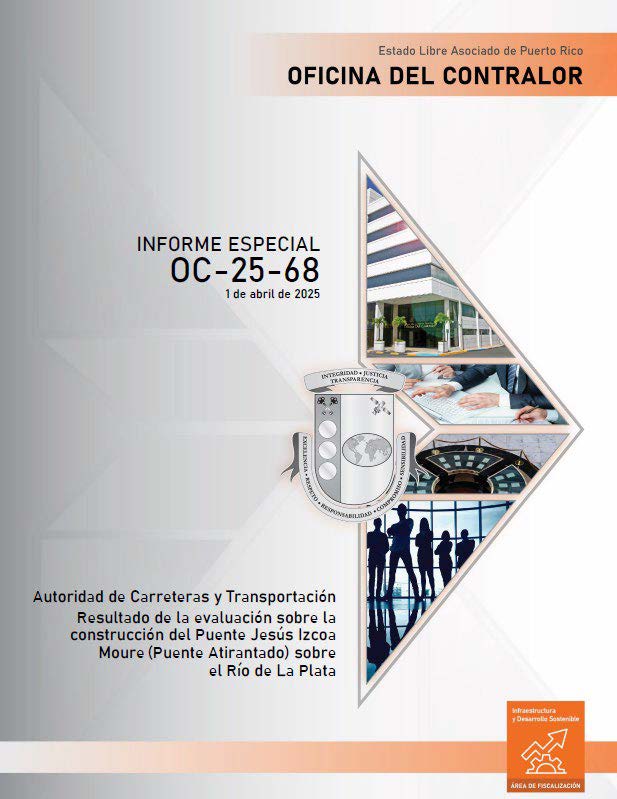
The Office of the Comptroller of Puerto Rico (OCPR) announced the results of the investigation into the construction of the Jesús Izcoa Moure Bridge (Cable-Stayed Bridge). The then executive director of the Highways and Transportation Authority of Puerto Rico (ACT) and current secretary of the Department of Transportation and Public Works, Edwin González Montalvo, requested on January 10, 2023, that the OCPR investigate the project, whose advanced deterioration pointed to an incorrect execution of the construction contract.
The investigation revealed that the Cable-Stayed Bridge was inaugurated on October 24, 2008, at the request of the ACT. The contractor indicated on October 23, 2008, that the bridge was substantially completed.
However, the designer reported that it could be opened, but with the restriction of avoiding heavy traffic and limiting the space to two pedestrians per square meter, until the bridge's tendons were tensioned and grouted. The designer further noted that it could not be guaranteed that the riding deck would not crack, and warned that the highest priority be given to completing the work on the tendons. Despite the warnings, two days after its inauguration the 10K el Chango race was held with 1,200 runners.
A month after its inauguration, the administrator reported that heavy traffic should not be allowed since it was causing excessive vibration on the deck and exerting an excessive impact on the anchorage, and that critical work remained to be completed. As of February 1, 2024, the ACT confirmed that it found no documentation explaining the reasons why the recommended restrictions were not carried out.
To this effect, the integrity of the structure may have been compromised, the safety of the bridge's users was put at risk, and this fact could have had adverse consequences for the ACT.
The Report, of eight findings, notes that 6% of the concrete placed on the bridge had a compressive strength lower than required. The ACT accepted the low-strength concrete placed on tower #4 after a structural analysis by the designer. However, there is no evidence that the validation was carried out for tower #5 or for the deck.
The inspection of the roughness of the riding deck surface revealed that it did not comply with the construction standards, and the contractor also did not present alternatives to correct the undulations as required. A 2016 inspection report by a private company informed the ACT that the edge beams were not straight and appeared to deviate from the alignments, and that this irregularity could be related to the undulations of the riding surface. However, these deficiencies were not corrected.
The director of the ACT's Construction Area certified that she had no knowledge of repairs and maintenance having been carried out on the bridge from 2010 to 2022. The executive director of the ACT certified that no maintenance plans for the bridge had been documented from 2008 to 2016 and that, since October 31, 2022, repair projects for $31 million have been underway.
The lack of planning in the maintenance work on the Cable-Stayed Bridge caused the ACT to have to incur contracting expenses of $31 million to carry out the inspections, the rehabilitation, and to commission a forensic audit to determine the deficiencies and assign responsibilities.
The evaluation reveals that the substantial completion date of the Cable-Stayed Bridge construction was moved up from May 8, 2010, to January 31, 2010, at the contractor's request and approved by the then regional director upon the recommendation of the supervising engineer. As of February 1, 2024, the executive director of the ACT had not made a decision on the payment of this “early completion bonus,” as indicated by the contract.
The contractor and the ACT formalized an agreement –Change Order– in 2019, for a negative amount of $1.4 million as part of the bridge construction payment settlement process. The Specifications Manual establishes that, upon completing a project, the engineer has 10 days to inspect and certify the work.
However, as of May 8, 2023, the final inspection had not been carried out, and on February 1, 2024, the executive director of the ACT certified that it is reviewing possible noncompliances on the part of the contractor.
The auditors detected that 30 amendments for $4.4 million awarded from 2002 to 2009 were not registered with the OCPR in violation of the current regulation. In addition, from 2015 to 2022, the ACT did not present to the Legislative Assembly detailed reports on the status and progress of all transit and transportation facilities, as provided by Act 74 of 1965.
The Report recommends that the designated Secretary of Justice and the administrator of the Federal Highway Administration in Puerto Rico consider the results of this investigation so that they take the measures they deem pertinent.
Special Report OC-25-68 dated April 1, 2025, is available on our website: www.ocpr.gov.pr.


Some documents on this page are saved in PDF format.
To view these documents, you must have the following free program installed.