The Government Commission of the House of Representatives held a public hearing this Monday on House Bill 320, which would create the “Act to Prohibit Donations to Political Parties or Candidates by Government Contractors and to Require Government Contractors to Disclose their Political Donations and Expenses”.
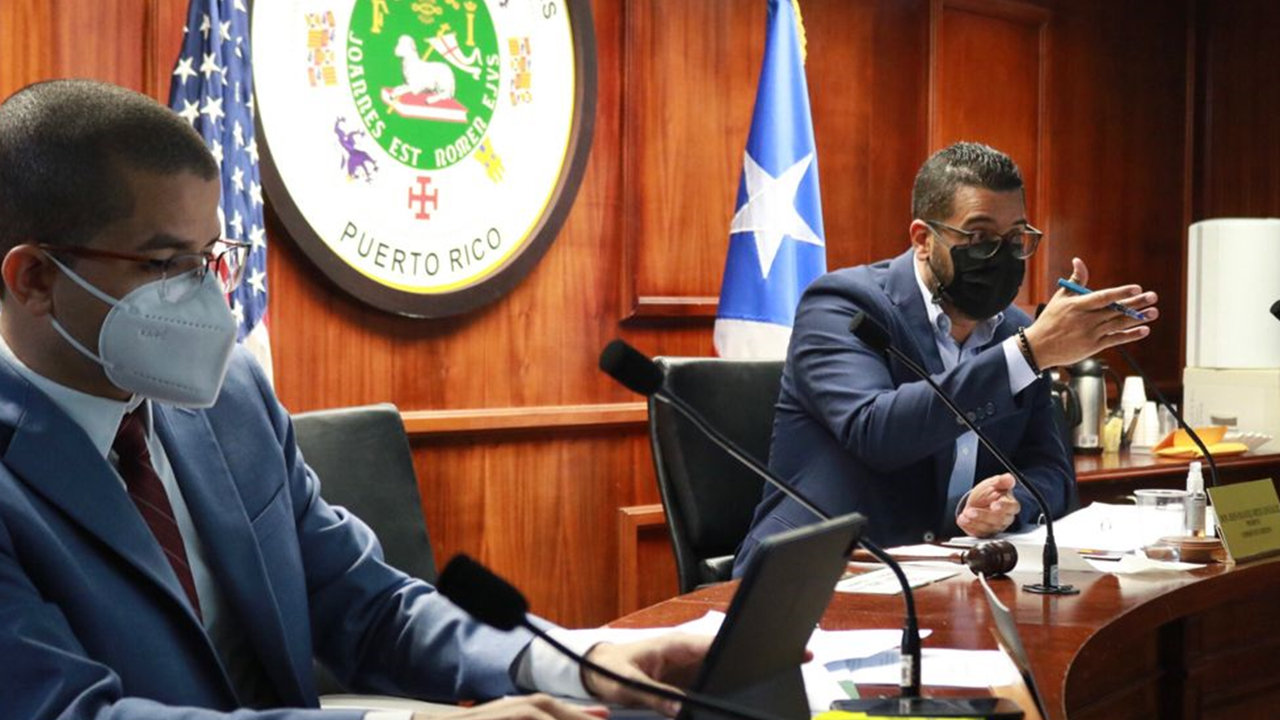
The measure seeks to require potential government contractors to disclose their political donations and expenses and to create the “Registry of donations and expenses of government contractors”.
Likewise, the statute will compel the disclosure of political donations made by individuals, prior to awarding them government contracts.
This prohibition has been adopted in the United States in at least 16 states, at both the federal and state level, and has been validated in the courts where the risk of corruption has been recognized when a contractor or a person interested in government contracts makes political donations.
The representative and author of the measure, Mariana Nogales Molinelli, explained that “the bill would establish sanctions and penalties for those who fail to comply with the law”.
Meanwhile, the chairman of the Commission, Jesús Manuel González Ortiz, expressed the importance of knowing the position of attorney Domingo Emanuelli, secretary of the Department of Justice, who was excused from the public hearing.
“It is necessary for the Department of Justice to clarify its position regarding this bill, due to the importance that its role implies within the nature of a measure like this”, said Ortiz González during his opening turn.
For his part, Walter Vélez Martínez, electoral comptroller, favored the adoption of the proposed public policy. “This measure contributes to combating government corruption in the form of political investment, that is, it helps prevent political donations from being made in exchange for official actions”.
Vélez Martínez proposed that, instead of creating a separate Act to address the issue of preventing “quid pro quo” (‘something for something’) in government contracting, the Bill should amend the organic laws of the agencies that will address the matter; Office of Government Ethics (OGE), Office of the Comptroller of Puerto Rico (OCPR) and Office of the Electoral Comptroller.
“This adjustment I propose to the Bill reinforces the jurisdiction and oversight authority of the Office of the Electoral Comptroller over political donations by government contractors that it seeks to regulate”, stated the Electoral Comptroller of the OCE.
On the other hand, Aniano Rivera Torres, interim executive director of the OGE, affirmed that “because the proposed measure involves the Office of the Comptroller and the Office of the Electoral Comptroller, we deem it necessary to obtain the observations of those offices”.
“It is unquestionable that government contracting must be free of political-partisan influences or favors. In addition, there must be a guarantee that decisions regarding government contracting must always safeguard the public interest in general and not that of particular groups. Thus, it is of utmost importance to legislate to ensure that contract award processes are fair and transparent, based on merit and not on political cronyism”, declared Rivera Torres.
Similarly, Yesmin Valdivieso Galib, comptroller, indicated that “at the OCPR we have been consistent in endorsing every effort that promotes sound public administration and the good use of resources for the benefit of our people. However, our office does not define or enact public policy”.
According to the Comptroller, Act 222, which created a Division for the Audit of Donations and Expenses as a division within the OCE, already establishes certain prohibitions related to the donations that both natural persons and legal entities can make.
“In fact, it is provided that no natural person may, directly or indirectly, make donations in or outside of Puerto Rico to a political party, aspirant, candidate, authorized campaign committee or political action committee in excess of $2,600”, set forth Valdivieso Galib.
Likewise, that will not apply to the Segregated Fund Committees or for Independent Expenditures that do not coordinate with or donate to any party, aspirant or candidate.
According to Valdivieso Galib, the OCE is the entity that has the knowledge, experience and legal authority to oversee, audit and adopt specific rules for the registries proposed by the measure.
“We understand that any statutory provision that affects matters related to political donations must be integrated into what is established in Act 222”, determined the Comptroller of the OCPR.
The government agency recommended that the comments that may be issued by the Department of Justice, the OGE and the OCE be taken into consideration.
Likewise, the three deponents agreed that “the bill is too broad as drafted” and demanded that the roles established in the measure for each government entity should be more specific.“If anyone is against corruption and knows the amount of money that is lost in government contracting, it is our office. However, when you have a measure that prohibits something to a citizen, it becomes very difficult, and I believe it is too broad a measure, in the sense that it makes no sense for a person to be excluded from doing contracting for giving 50 dollars in donations, or worse, to think that for giving that amount that person is corrupt. Something that seems illogical and ridiculous to me”, emphasized Valdivieso Galib.


Some documents on this page are saved in PDF format.
To view these documents, you must have the following free program installed.