On December 7 oversight agencies signed a Collaboration Agreement to work together on corruption investigations. The team is made up of the agencies: FBI of Puerto Rico, the Federal Prosecutor's Office, the Office of the Inspector General of the federal Department of Education, the Office of the Inspector General of the federal Department of Housing and Urban Development, the Office of the Inspector General of the federal Department of Labor, the Department of Public Safety (DSP), the Office of the Comptroller of Puerto Rico, the Office of Government Ethics, the Office of the Inspector General of Puerto Rico, the General Services Administration (ASG), and the Bureau of Special Investigations (NIE).
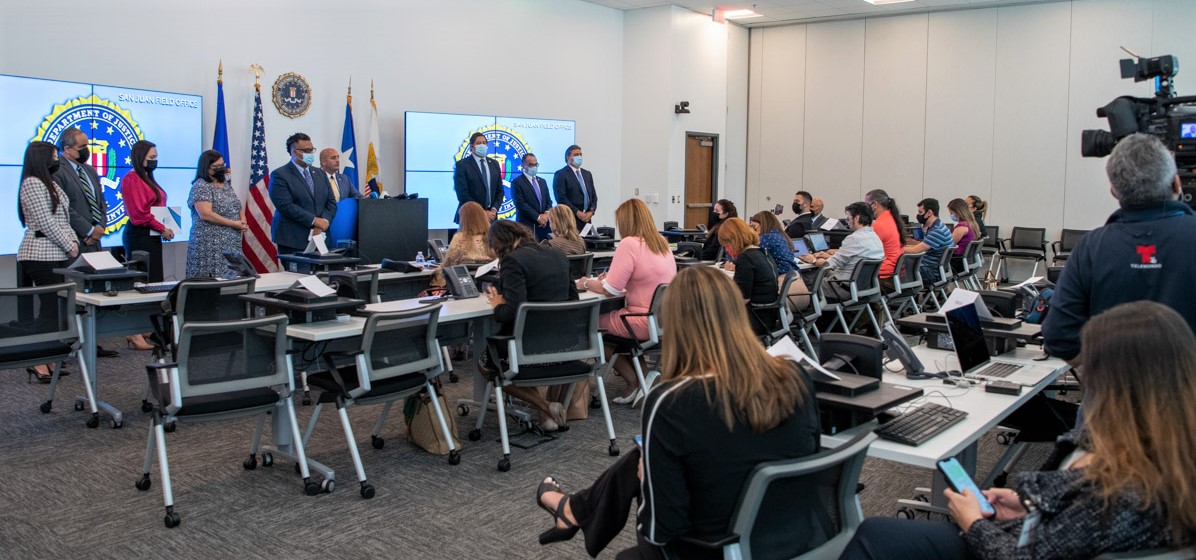
The Federal Bureau of Investigation (FBI), and several state and federal agencies, announced today an important and historic collaboration agreement, through which a working team against corruption is created.
As the special agent in charge of the FBI in Puerto Rico, Joseph González, explained, under this agreement all the participating agencies would have resources assigned to the anti-corruption “task force,” some working full time from the FBI headquarters in San Juan, so that cases can be handled more quickly, more efficiently, and from every possible angle.
In addition to the FBI, also participating in the agreement are the Federal Prosecutor's Office, the Office of the Inspector General of the federal Department of Education, the Office of the Inspector General of the federal Department of Housing and Urban Development, the Office of the Inspector General of the federal Department of Labor, the Department of Public Safety (DSP), the Office of the Comptroller of Puerto Rico, the Office of Government Ethics, the Office of the Inspector General of Puerto Rico, the General Services Administration (ASG), and the Bureau of Special Investigations (NIE).
“For years the FBI has been part of collaborative efforts to promote and expedite investigative processes in matters of national security, gangs, drugs, and violent crimes, which have been very successful. We had never created a working group, or 'task force,' to address the issue of corruption in Puerto Rico,” affirmed Joseph González, special agent in charge of the FBI in Puerto Rico.
“Each agency present today has historically handled these matters according to its internal procedures and the laws that apply to it individually. This group will be made up of investigators from the various agencies, with the purpose that, when a corruption allegation arrives, it can be evaluated at the federal, state, and administrative level in a coordinated way,” González added.
The head of the FBI in Puerto Rico added that the purpose of the initiative “is that the behavior, whether criminal, negligent, or of mere carelessness, of public officials, always has a consequence.”
“The purpose is to work jointly with federal and state agencies in order to be able to use all the available tools to address corruption allegations in a more complete way,” González insisted.
The head of the FBI also highlighted the importance of the collaboration of citizens and the press in reporting corruption and urged any person who has knowledge of any situation that could mean an act of corruption to come before the authorities and report it.
Likewise, as he has done in many of his public presentations, González urged any official who is involved in acts of corruption to come before the authorities before they knock on their door.
In a similar way, executives from the other agencies involved echoed González's words, as well as the call for the people's cooperation in reporting corruption, and for those involved in corruption schemes to step forward and collaborate with the authorities.
Federal prosecutor Stephen Muldrow, head of the criminal division of the Federal Prosecutor's Office, highlighted that public corruption “has a horrible impact on public programs,” and reminded any possible person involved in acts of corruption that “the faster you come to us, the potential benefit for you is much greater… step forward as soon as possible, because sooner or later we are going to find you.”
Rafael Riviere, undersecretary of the DSP, described “the damage that corrupt officials do” as “one of the worst cancers of civilized society.”
“They are the worst kind of criminals. These people justify their actions and justify them to the people. The number of victims is in many cases greater than the victims of other crimes that occupy us daily,” affirmed Riviere, adding that the six bureaus under the DSP would be cooperating with the initiative.
To questions from the press, González insisted that “the people are tired of corruption” and the 'task force' they were announcing was an example of how they intended to combat corruption. “It is going to be worked on completely transparently, sharing information. It will not be tolerated.”
Even though it is expected that with the initiative the time of the investigations can be shortened a little to bring the corrupt before justice, the leaders of the different agencies present at the announcement recalled that this type of investigation usually takes quite a long time, so that all the necessary evidence can be gathered for the cases to hold up in the courts.
González, however, commented that when they spoke of a 'task force' they were speaking of “agents, analysts, investigators, auditors, who are going to be working day to day, shoulder to shoulder, with this building (the FBI's headquarters in San Juan), with our system, sharing information, and all of that is going to help cut through the bureaucracy. That is going to keep cases from taking so long and waiting for different reports, because they are going to be working together in these offices.”
To questions from this newspaper about the call for citizen cooperation and the degree of protection that those who report could expect, the head of the FBI assured that “protecting our sources is the most important thing, because without them we cannot make our case.”
“If everyone knows, let them call. We can have information, but if there is no evidence a case cannot be made. And if they have that information what we are asking is for them to call. We are going to protect the confidentiality of all the people who cooperate with us,” González commented. “We do not make cases alone. We have done it for more than a hundred years with the cooperation of the people, of our sources. And for us it is very important, and we do everything possible to protect our sources.”
In fact, although he did not give specific numbers, González commented that “since last week,” when the arrest of a contractor related to the corruption case against the former mayor of Cataño took place, “we have seen an increase in calls about corruption complaints. It has been more than normal.”
On the other hand, González clarified that “we are not going to wait for tips to arrive, we are going to be in front of the threat. We are not going to be reactive, we are going to be proactive. The commitment of the FBI and all the agencies present here today is that we are going to give everything against corruption.” He added that, even though they have people from so many agencies working jointly, in each case it would be evaluated whether the cases are taken to the state or federal level, depending on which of the forums they consider they can obtain better results.
The special agent in charge of the FBI in Puerto Rico, Joseph González, described public corruption on the island this Tuesday as «a cancer,» this after announcing at a press conference a collaboration agreement with multiple federal and state agencies to create a “Public corruption task force” to combat public corruption on the island.
“Corruption is a cancer… the people are tired of corruption… it is going to be worked on completely transparently, sharing information, and as my colleagues have said, it will not be tolerated (corruption),” he said to questions from Foro Noticioso.
González commented that many people have contacted the agency to offer tips, although he declined to indicate what or whom they were about.
He added that “the cases are going to come out when they are ready; a Task Force is the investigators who are going to be working sharing information to help shorten the bureaucracy so that they do not take so long.”
For her part, the Comptroller Yesmín Valdivieso affirmed that the Office of the Comptroller does not wait for the report to be adjudicated to make the referrals.
“The reports take the time they have to take to come out correctly, but we certainly do not wait for the report to be published to make the referrals; this is worked on beforehand and in the office we have tried, as soon as we understand that something is happening, to do a preliminary investigation, we immediately refer it,” she said, adding that the investigations take time. At the conference, in addition to the FBI and the Comptroller Yesmín Valdivieso, also participating were the deputy director of the Office of Government Ethics Aniano Rivera Torres, the federal prosecutor W. Stephen Muldrow, and the secretary of the Department of Public Safety, Alexis Torres, among others.


Some documents on this page are saved in PDF format.
To view these documents, you must have the following free program installed.