As a strategy that, they assured, will promote the expediting of federal fund disbursements without compromising the integrity of the transactions, the Central Office of Recovery, Reconstruction and Resilience (COR3) and the Office of the Comptroller agreed this Thursday to share access to their respective information systems and to resort to artificial intelligence tools to detect irregularities in the management of the billions of dollars allocated annually to infrastructure projects.
According to the executive director of COR3, Eduardo Soria Rivera, the collaboration agreement with the recently confirmed comptroller, Carmen Vega Fournier, is “broader” than the one in force with her predecessor, Yesmín Valdivieso, and will also give way to continuous training sessions for personnel of both entities.
In light of Governor Jenniffer González's directive to “facilitate the disbursements” to subrecipients of federal funds –agencies, public corporations, municipalities and nonprofit entities–, Soria Rivera said that “compensating” controls will need to be implemented, a function that, in his judgment, the auditors of the Office of the Comptroller will be able to fulfill.
“(The difference) is where we place the control. Now, we have them before the disbursement; some of them we are going to place after the disbursement. That is going to require that, if an inadequate, improper or should-not-be-made disbursement was made, there will have to be a process to recover those funds, and nobody dies because reconstruction is not going to end this year or next. Nothing happens if we disburse more quickly and the Comptroller tells us ‘this disbursement was not adequate.' We are going to have debts with the subrecipients anyway and the opportunity to recover those funds,” he assured.
In 2024, COR3 transferred more than $2,000 million to subrecipients, an amount that Soria Rivera has anticipated he expects to double over the next few years.

Through the agreement, the auditors of the Office of the Comptroller will have access to COR3's databases in “real time,” which will allow continuous monitoring. In parallel, COR3 will be able to access both the Comptroller's Registry of Contracts and the system of Notifications of Losses or Irregularities, where irregularities associated with federal projects can be reported.
According to Vega Fournier, who was sworn in a week ago as comptroller –a position that runs for 10 years–, this is an initiative she also hopes to implement soon with central government agencies and municipalities.
Soria Rivera specified, meanwhile, that COR3 has three auditors, but stressed that the agency cannot be “one more auditor,” a role that, from his perspective, should be assumed by the Office of the Comptroller and the Office of the Inspector General (OIG), as well as the Federal Emergency Management Agency and other entities of the U.S. government.
In response to the assertion that, historically, the Office of the Comptroller has been characterized by conducting audits and presenting findings years after the irregularities occurred –hindering corrective actions or the prosecution of crimes–, Vega Fournier insisted that it is an aspect she intends to change.
“When I was at the Bank (of Economic Development –which she chaired until her confirmation as comptroller–), the cases could take eight months to be evaluated and, afterward, they were evaluated in 30 days. That same thing is going to happen at the Office of the Comptroller. First, we are going to integrate artificial intelligence. We have been in conversations with large firms in Puerto Rico and we are integrating the same practices into the Office of the Comptroller,” Vega Fournier noted.
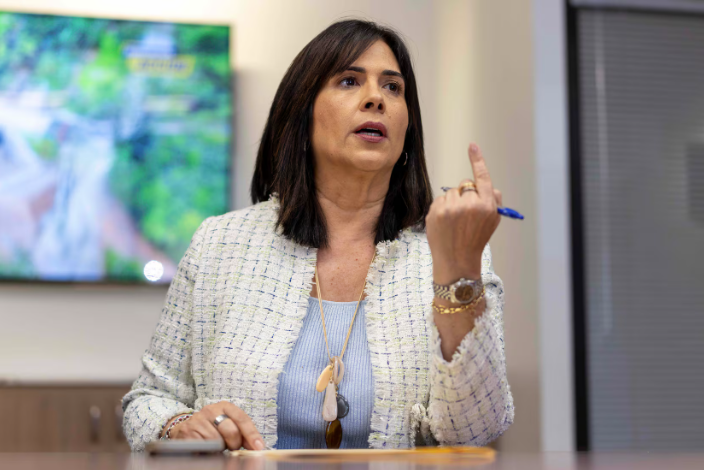
“I am going to be quite open about referring everything, and they will know what they investigate and under what criteria. It seems to me that part of the commitment is to do more practical and faster audits, perhaps, of specific topics. If the municipality of Isla de Mona is due for an audit in two years, but I make a referral, they are going to (investigate) that. You are not going to wait the two years. It is going to be more ‘targeted,'” Soria Rivera affirmed, for his part, stressing that, to avoid duplication, it will be up to the comptroller to maintain continuous communication with the OIG and federal agencies.
Soria Rivera and Vega Fournier did not rule out that, in the future, Office of the Comptroller personnel may be assigned to work exclusively on COR3 matters.
Although he could not offer statistics, Soria Rivera assured that COR3 stops payments “all the time” when identifying irregularities, although he stressed that not all situations amount to commissions of fraud or corruption.
He highlighted that, in collaboration with the Office of the Comptroller, they intend to require nonprofit organizations that receive federal funds to submit their contracts to the public registry, as well as to offer more data about subcontracting, elements that could require legislation. Although he acknowledged that this determination could generate criticism from the third sector, he emphasized that, in the long run, it will promote greater “sophistication” of these organizations.
“The hope is to strengthen the nonprofits so that, in a next disaster, instead of channeling everything through the government, those entities are used. If I strengthen and give structure to the nonprofits, it benefits me and they grow. Sometimes, they don't realize that, with weak structures, they condemn themselves to staying small,” he mentioned.


Some documents on this page are saved in PDF format.
To view these documents, you must have the following free program installed.