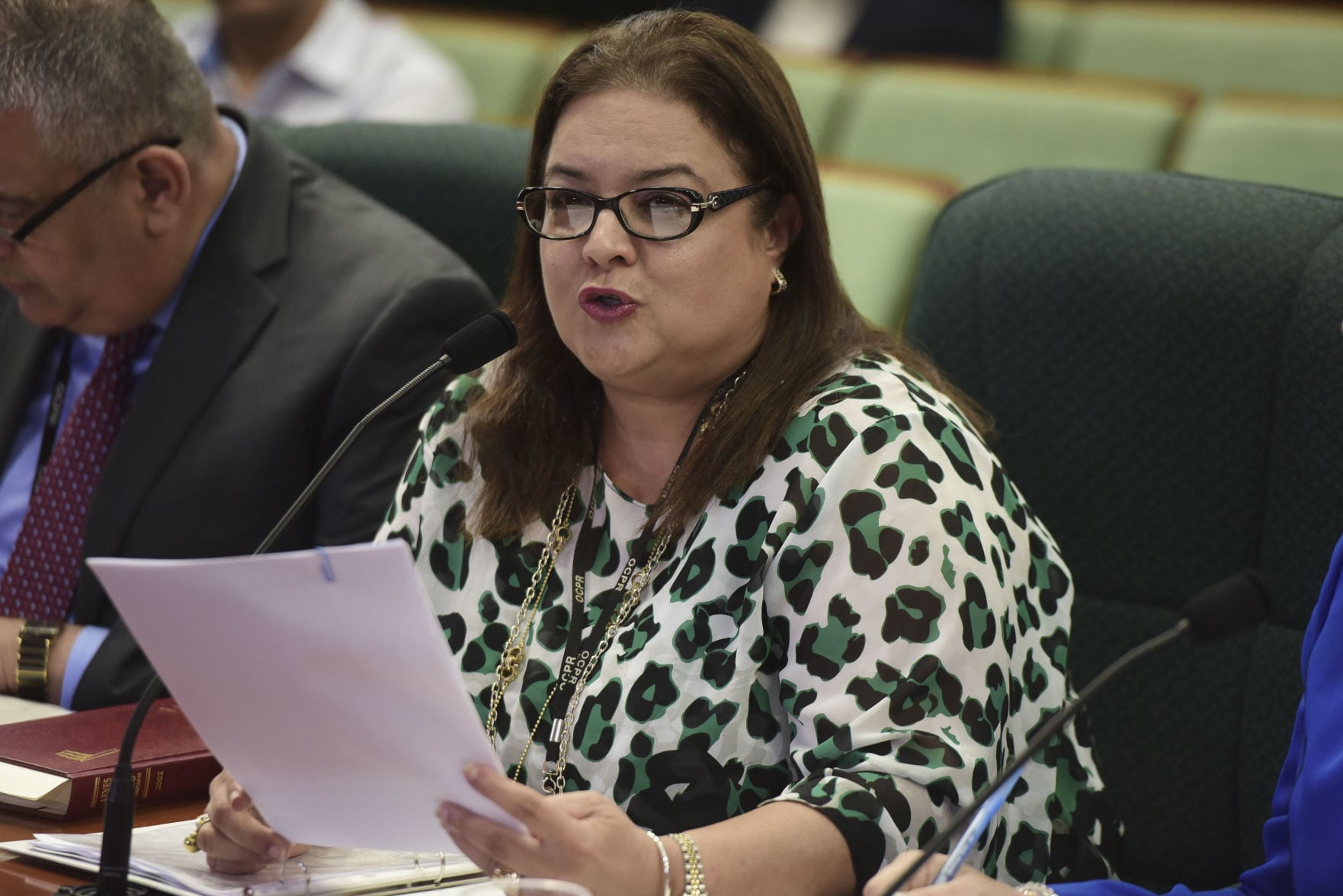
“We have been making these observations for years, I understand that they do not pay attention to us, it is frustrating”, Yesmín Valdivieso Comptroller of Puerto Rico. >Carlos Rivera Giusti/EL VOCERO
Year after year, again and again, agencies, municipalities and public corporations commit the same failures of sound administration. Sometimes intentionally and at other times out of incompetence. In many cases the persons responsible for the faults cannot even be identified and the Office of the Comptroller cannot reprimand anyone.
This situation, for the head of the agency Yesmín Valdivieso, is a frustrating one and evidence that, despite the audits, the publicity they receive in the media and the problems of public servants with law-and-order agencies, they do not pay attention.
“I would like to see at some point that contracts are done well, that the amendments are no longer made retroactively, to see that all quotes are requested. I do not want to see another finding that a job is given to an engineer without a license. We have been making these observations for years, I understand that they do not pay attention to us, it is frustrating”, Valdivieso expressed in an interview with EL VOCERO.
This past September, Valdivieso made a similar call to the municipalities, to the central government and to the various government instrumentalities, to follow her recommendations to avoid administrative problems. But her request fell on deaf ears.
Lies abound
Regarding the municipalities, she stated that in the vast majority, failures with the quotes are detected, either because they were not requested or because they are false. She considered that mayors should hold the directors of the purchasing divisions accountable when these situations occur.
She opined that these directors should verify that buyers comply with the regulations. “They have to call and confirm because the quotes are their responsibility. And then we cannot find who falsified them, but we also cannot reprimand anyone. The same thing will happen in the next audit and we will find the same thing. I would have a solution: I would give a reprimand to the purchasing person, the second time it happens I put it in writing (in their file) and the third time I tell them ‘you are of no use to me’. Purchases and contracting are the most frequent”, she affirmed.
“And everyone stays quiet, no one says anything, no one wants to get into trouble. When we see false quotes and we ask (the business owners) if they sent the quotes, they tell us no, that it is not even the letterhead of the business, that it is not the paper they use, and then, who did it? They tell us ‘oh, I don't know’. Then no one knows anything. Someone has to be held responsible. If I were the head of purchasing or a buyer, I would have picked up the phone and confirmed and done what has to be done, that the municipality make them and not allow others to make them. The truth is that since we cannot find a culprit, nothing is happening to the one who failed to do their job either”, she added.
Engineers without a license
Another frequent failure is the contracting of engineers without the required licenses or who are not constituted in a professional corporation or organization.
She mentioned the case of former senator Roger Iglesias, who, as president of Engineering Communications Group, Inc., obtained two contracts with municipalities even though he did not have the license to practice engineering. However, the Department of Justice, in 2012, decided not to take action against the former legislator of the Partido Nuevo Progresista.
“They have not realized how easy it would be to say (to the agency heads and the mayors) ‘I cannot hire you. I am sorry because you do not have a license. Unless you are in a professional corporation I will not be able to give you that job’, how easy it would be”, she remarked.
Justice wants to help
On the other hand, she revealed that she recently held a meeting with the Secretary of Justice, Wanda Vázquez, who indicated her interest in “helping more”.
“We were talking to see how a prosecutor can be inserted into the investigations we do, but early in the process. So that it is not the case that we do the investigation alone and send it to them and then they have to investigate again. She is looking into whether she assigns specific prosecutors to work with us more or less the same way we work with the federal authorities”, she noted.
The lack of resources is deadly
On the other hand, she highlighted the decrease in personnel in her office, which has translated into a decline in the number of audits. She has lost 45 employees, mostly high-level.
“We were discussing that before they began to resign and retire, the average number of audits per year we did was 114 and 115. At least right now we have 82 audits, but we are saddened by that because it will be noticed”, she remarked.
This is why they are trying to carry out shorter audits to see if they can increase the number.
“I have had to keep moving people around (to replace those who have left). We are trying to do the same work with fewer people and without recruiting, but somewhere I fail. What we are doing, for example, is telling everyone that the audit has to be done in half the time in order to comply with the audits we have”, she stated.
On the other hand, she considered that on occasion the decrease in government personnel affects the work of collecting money. She mentioned that an example of this is the case at the Driver Services Centers (Cesco) in Arecibo.
This past week the office detected deficiencies in the receipt and handling of the administrative fine tickets issued by law-enforcement officers. The auditors found 55,650 tickets from the years 2006 to 2011 with a total value of more than $3 million that were not sent to be digitized at the Directorate of Driver Services.
“Those tickets were never processed. I am sure that the public will be very happy that they were never charged, but the truth is that a bankrupt government should not afford the luxury of not processing that fine”, she expressed.
She affirmed that the situation that occurred at the Cesco in Arecibo has been repeated for years at other similar centers, according to what the deputy director of her office has informed her.
“In Puerto Rico there are 16 Cesco. If we project that in Arecibo $3 million was lost, multiply that by 16. We are talking about $48 million. It may be that in the Cesco of San Juan and of Bayamón they are higher. Do you know how many holes you can plug with $48 million?”, she stated.
“Then what happens, I think, and this is very difficult to put in a recommendation to the Fiscal Oversight Board. The board and the governments, since I have been here, have the vision that is the same as that of the people, that we have a government that is too big, of ‘let's shrink the government’. Making a silly calculation, if I pay an employee $10 or $15 an hour, no matter how slow the person is, at a minimum they have to enter into the system about four fines. Is it not more effective to have a person who is paid $10 and can process $100 in revenue? What we lack is a clearer vision. Sometimes we box ourselves in with the idea that we have to make the government smaller”, she added.


Some documents on this page are saved in PDF format.
To view these documents, you must have the following free program installed.