The United Nations Convention against Corruption (UNCAC) is a multilateral treaty of the United Nations Organization aimed at preventing and combating political corruption, promoted by the United Nations Office on Drugs and Crime (UNODC). It was adopted on October 31, 2003 by the United Nations General Assembly and entered into force on December 14, 2005. The UNCAC is considered the main international instrument for addressing corruption in all sectors.
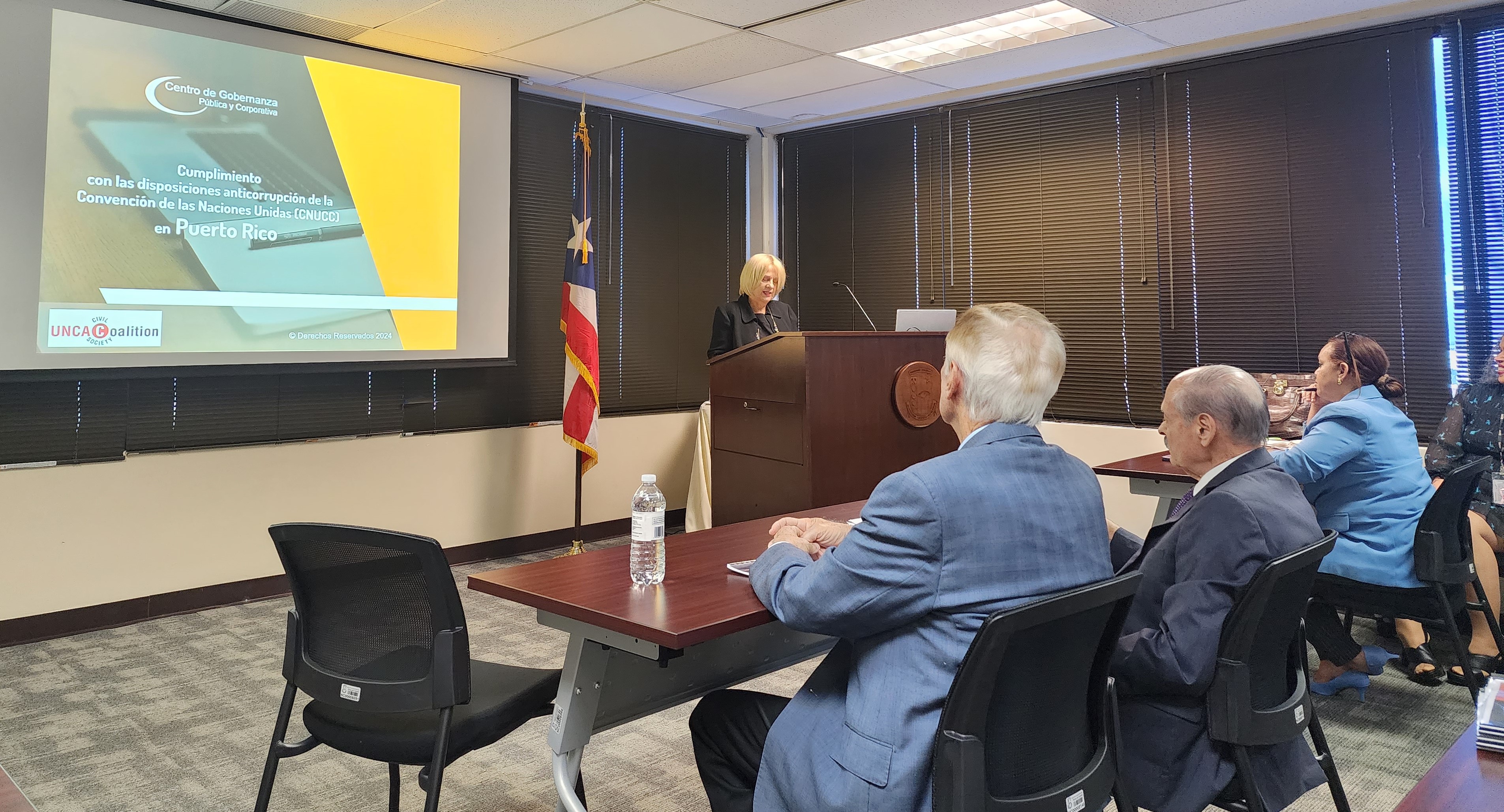
The Center for Public and Corporate Governance (CGPC) is a civil society organization that, as a member of the UNCAC Civil Society Coalition, conducted a study aimed at evaluating Puerto Rico's legal framework and anticorruption strategy and its compliance with the provisions of the UNCAC. This initiative is a collaborative effort of the CGPC with the United Nations Convention against Corruption (UNCAC) Coalition. To carry out the study, a methodology was applied that used various techniques to gather information, which included documentary analysis, analysis of the OCPR's audit reports, the design of a self-assessment questionnaire on compliance of Puerto Rico's legal framework and anticorruption strategy with the provisions of the UNCAC, among others.
As part of this methodology, on November 16, 2021 a focus group and a SWOT analysis were conducted with executive and management personnel of the Office of the Comptroller of Puerto Rico (OCPR). The OCPR personnel were tasked with evaluating government performance and used as criteria the anticorruption indicators and principles established by the UN, which are categorized into:
On March 16, 2022 the CGPC presented to the Comptroller of Puerto Rico, Hon. Yesmín M. Valdivieso, and to the OCPR officials who participated in the focus group, the report Self-assessment of Puerto Rico's compliance with the anticorruption provisions of the United Nations Convention against Corruption. The report contains the findings, conclusions, and recommendations to address the areas for improvement identified in the focus group. Among the results, the need to strengthen the system of governance and management of public affairs to improve the delivery of services to citizens stands out. In addition, the study revealed that Puerto Rico partially complies with the anticorruption provisions of the UNCAC regarding the categories of information related to preventive measures and to the legal and regulatory framework, and that it does not comply with what is related to the criminalization of corruption practices. The presentation of the results sparked a productive exchange of ideas and recommendations to develop and establish the actions required to strengthen the legal framework and anticorruption strategy.
On June 9, 2022 the CGPC presented the Action plan to guide the implementation of the recommendations of the research study on the Self-assessment of Puerto Rico's compliance with the anticorruption provisions of the United Nations Convention against Corruption. This Action Plan is the result of the work done with the participants of the OCPR focus group on March 16, and includes the good-governance best-practice strategies suggested to mobilize the improvement of Puerto Rico's compliance with the anticorruption provisions of the UNCAC. Among the best practices are:
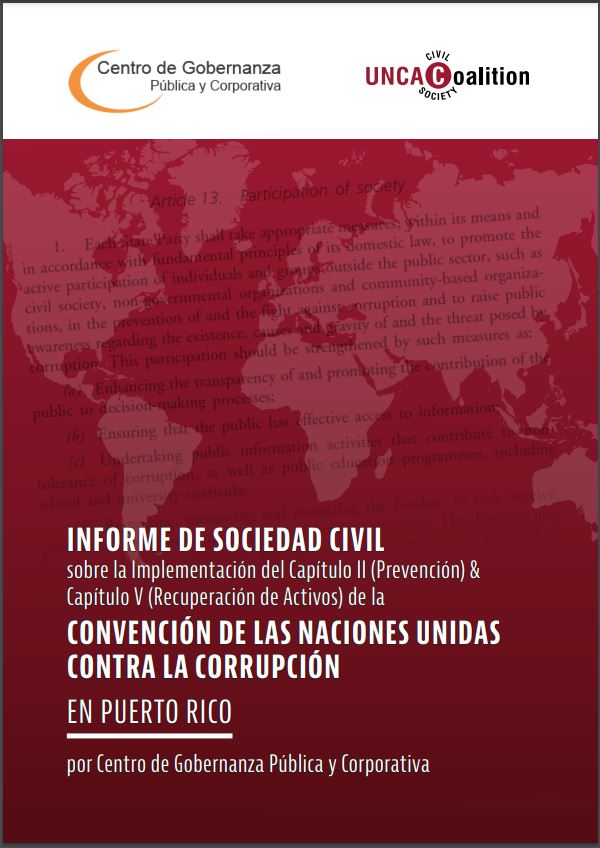
On January 19, 2024 a conversation was held between the CGPC and the focus group participants in which ideas and experiences were exchanged about what was set out in the Civil society report on the implementation of Chapter II (Prevention) & Chapter V (Asset Recovery) of the United Nations Convention against Corruption (UNCAC) in Puerto Rico prepared by the CGPC and presented before the United Nations in November 2023. The recommendations of the report are aimed at providing support to the government of Puerto Rico in strengthening the strategy and legal framework to prevent, combat, and criminalize corruption.
For the Office of the Comptroller, participating in this type of study and research is of great relevance, since corruption is a bad practice that operates to the detriment of sound and transparent public management. It is a phenomenon that has affected Puerto Rico for decades, eroding trust in government. This makes it necessary to create a common front in which state and federal government agencies, and civil society and private sector institutions become proactively involved to establish and put into operation public policies for the benefit and well-being of citizens.


Some documents on this page are saved in PDF format.
To view these documents, you must have the following free program installed.