Alejandra Jover, EL VOCERO 03/23/2023
They propose to recover the money from public funds implicated in corruption schemes
The Secretary of the Department of Justice, Domingo Emanuelli Hernández, reported yesterday that he will implement legal mechanisms to recover the public funds implicated in corruption schemes of government officials or of private contractors who have illegally profited from government coffers.
“We are aimed at recovering the money of the Puerto Rican people. Together with the governor, Pedro Pierluisi, we have been evaluating various mechanisms to curb public corruption, as part of this administration's security plan and anticorruption policy. Among these is the possibility of initiating civil lawsuits to recover the public money embezzled or illegally appropriated, whether by officials or persons from the private sector who have failed Puerto Rico. For this we will have to carry out a case-by-case evaluation. We want them to return what they have stolen from the people,” the Secretary of Justice stated in a press release.
Last year the governor approved an amendment to the Penal Code of Puerto Rico, by means of Act 76-2022, which provides for the penalty of restitution, whether in money, through the provision of services, or the delivery of the illegally appropriated goods.
“Through this statute, we could recover the money in the criminal proceeding,” Emanuelli Hernández explained.
Comptroller Yesmín Valdivieso — in light of the case being heard in federal Court against Ángel Pérez, the former mayor of Guaynabo — told EL VOCERO that many of the persons convicted of acts of corruption had to hand over what they had to the federal government, but she does not know whether the federal entities will return it to the treasury.
“Certainly, what are public funds are supposed to be recovered, period, and that effort corresponds to the Secretary of Justice.”
“Whether they have money to pay is another matter entirely. Whether it is determined that they are public funds is another issue; much of this money came out of the personal accounts of those who made the payments, and being able to think that the money they had came from public funds is a bit more complicated to evidence,” Valdivieso explained.
“But the general rule is that lost public funds are funds you have to recover,” she emphasized.
“Does recovering that money repair the public harm?” we asked.
“The harm that has been done will never truly be erased,” the Comptroller responded.
In reference to the visit of Donald Trump, then president of the United States, after Hurricane María, she warned that “when they put the label on you of ‘Look at all the corrupt people that exist in Puerto Rico,' it is very difficult to remove that idea from people.”
Valdivieso concedes that there are corrupt people at all levels of society, but the blame falls on everyone.
“We are many decent people who work and don't have to steal from anyone. There are people who were stealing simply because they could do it,” she indicated.
“The harm is done. Many years will pass before this bad reputation is forgotten,” she lamented.
The Comptroller added that in acts of corruption 5% of the gross product in the world is lost, “and we are talking about trillions of dollars. It is a worldwide evil, but unfortunately the names of those people are not known. Here we know who they are and who failed the people of Puerto Rico, and that is very difficult to swallow and forgive.”
Denouncing corruption
Valdivieso noted that with the Stop corruption campaign, of the agency's Special Investigations Division, they have managed to file several complaints based on information provided by the public.
People can report harm or neglect to the government's movable or immovable property, appropriation or embezzlement of public funds, illegal purchase of materials or equipment, irregularities in bids, undue intervention in the procurement process, contracts onerous to the treasury or that have been awarded in violation of laws and regulations, and “ghost” employees who receive salary without working.
“We could never know if someone is committing acts of corruption unless someone gets upset, gets tired and reports it,” Valdivieso stated.
“Stopping corruption is possible, but we need that, if you know someone committing illegal acts, you contact us,” she noted.
In addition to the Office of the Comptroller, complaints can be filed with the Office of Government Ethics, the Department of Justice, the Federal Bureau of Investigation (FBI) or the Office of the United States Attorney for the District of Puerto Rico.
Transparency is vital
Manuel Quilichini, president of the Bar Association of Puerto Rico, agreed with Valdivieso that it is up to Justice to recover the money lost due to corruption.
“It is up to the Department of Justice because it is the law firm of Puerto Rico, not only in the criminal part but also in the civil part. So in that sense I agree with Yesmín Valdivieso that it is up to Justice to recover the stolen money,” he indicated.
“As to whether it should do so or not, I understand that they have stolen a lot of money from us, people freely confess that they have stolen from us but then, what are the consequences? It may be going to prison, but sometimes it's for a short period of time. The people who have stolen have profited incredibly; just look at the case of Víctor Fajardo, who stole millions of dollars, which is the people's money. I understand that the law is there for recovery,” the lawyer pointed out.
He added that recovering the money can be difficult because the officials spend it and have nothing left.
“Frankly I believe that trying to recover the money can be quite an uphill battle, but the attempt should be made because it is a deterrent to those who want to keep stealing. As for confidence in our institutions, what we need is transparency. The government does many things behind the public's back and that is what causes suspicion. If they knew how to put everything on the table — who wins a bid, how much is paid — transparency attacks the root of corruption,” Quilichini elaborated.
To learn more about the Stop corruption program and to make reports anonymously, visit https://www.ocpr.gov.pr/querellese/
The journalist Glorimar Velázquez collaborated on this story.


Some documents on this page are saved in PDF format.
To view these documents, you must have the following free program installed.


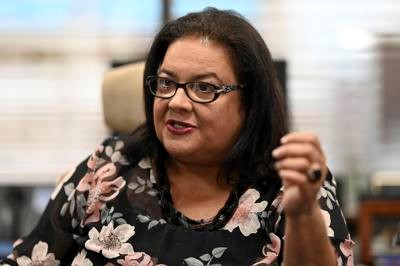 Valdivieso noted that with the “Stop corruption” campaign of her agency's Special Investigations Division, they have managed to file several complaints thanks to information provided by the public. >File / EL VOCERO


